Border War, 1855-1856
The World of Fiddler’s Green

NEMESIS FICTION has published Chapter 6 of my novel, Fiddler’s Green, which means now I can talk about the Border War between the Free States of America and the Confederated Southern States. This conflict serves as protagonist Jesse Lovelace’s introduction to formal warfare, after the guerrilla clashes he has participated in during earlier chapters. It is also where the influence of technology really begins to have a drastic effect; the steampunking intensifies in this chapter.
When we learn about wars in history class, we are almost always given a pair of dates to memorize. 1861-1865. 1914-1918. 1939-1945. Those dates generally mark the period at which a war is at its highest intensity, but it is misleading to think that those dates encompass the whole of a particular conflict. It’s more useful to think of periods of gradually rising violence, which eventually rises to the level of “war,” followed by another period of decreasing violence. For instance, the War of Northern Aggression is more properly thought of as beginning with the Bleeding Kansas era in the 1850s, and not ending until the withdrawal of Union troops from the South in 1877.
Thus in the world of Fiddler’s Green.
Casus Belli
The Free States of America began the conflict in 1852, with three specific aims.
Capture the entire Delmarva Peninsula, giving them control over the mouth of the Chesapeake Bay.
Capture the coal-producing regions south of the Ohio River, in the area of the Kentucky-(West) Virginia border region, along the Big Sandy River. The increased industrialization of this timeline makes this a desirable acquisition.
Acquire the northern half of Missouri, and set the border at the Missouri River. The access to the river would allow the Free States to increase settlement into the territories west of Missouri.
Rarely is a government honest enough to admit its real goals when they use warfare as a tool of statecraft, and the FSA is no exception. Founded as they were on opposition to slavery, they use that as their primary justification. As seen in previous chapters, they seek to encourage plebiscites in the territories they want, using deniable militias to influence the outcomes.
A contributing factor to the eventual outbreak of open conflict is the CSSA’s inattention to its own interests. The general attitude of the Confederate government is essentially “we just want to be left alone.” Remember, in this timeline it was the North that seceded, and the South just let them go. Most Confederates are genuinely perplexed at the prospect that the FSA would want conflict. Furthermore, the CSSA’s central government is weak, and has few mechanisms for intervention in their own internal affairs; such things are left to individual states. Thus, you have the scenario of Chapter 4, where a faction of military officers is acting largely on their own, by way of a local militia.
The War Begins
Eastern Theater
The FSA begins the war in the east by launching an incursion from southern Pennsylvania in April 1855, headed for Baltimore. With the northern land route cut, the Delmarva Peninsula is isolated. A second invasion force crosses into Maryland from Delaware, and then turns south towards Virginia. At the same time, a naval flotilla leaves from New Jersey, seeking to prevent reinforcement of the peninsula from the mainland. The steam-powered ironclads of the FSA meet the obsolete wooden fleet of the CSSA, inherited from the USA, and defeat it off Hampton Roads, and then move north into the bay. Isolated, the local militias and regular troops on the peninsula are defeated in a series of battles, and the FSA moves down to the southern tip.
The CSSA military moves the bulk of its combat power to protect the important port of Baltimore, culminating in a siege marked by the use of modern steam-powered artillery on the city and widespread loss of life, in the summer of 1855. However, this is a feint. In August 1855, an invasion force crosses the Chesapeake Bay and moves up the James River. Richmond, the Confederate capitol, is under siege by October. The CSSA army moves all available forces to the city, and holds out until March 1856, when it finally falls.
Central Theater
The mountainous coal country that the FSA seeks to capture is an area of few roads, ideally suited to defense, and the military high command is wise enough not to attempt a land invasion. A fleet of ironclads moves down the Big Sandy and Licking Rivers, landing troops to capture coal mines and strategic towns. They face little organized resistance beyond local militias initially, and achieve their goals quickly.
As in our timeline’s Civil War, the South can spare little military power for this theater. A flotilla of Southern gunboats attempts to sail up the Ohio River, in an attempt to recapture the mouths of the Big Sandy and Licking, but is stopped by shore batteries near Cincinnati. A serious guerrilla resistance costs the FSA numerous troops and a few ships as the war goes on, but never enough to break their hold on the territory.
Western Theater
This is where the action of the novel occurs. At the outbreak of the war, the FSA launches a two pronged invasion of Missouri. One column, from Fort Madison, Iowa, moves toward St Louis and puts it under siege in April 1855. A second column originates from western Iowa, where a rail line was specially built to support them, with Columbia as its target. The CSSA military puts the majority of the available troops into the defense of St Louis, but a hastily raised volunteer army from Missouri, Arkansas, and the Cherokee Nation, accompanied by a Republic of Texas expeditionary force, moves out of Columbia. They intercept the Free State force at a crossing point on the Chariton River, and defeat them in April 1855. This army then turns east, and cuts the land supply line for the force besieging St Louis. In its only real success of the war, the CSSA navy defeats the FSA gunboats on the Mississippi, cutting off the besiegers from resupply by water.
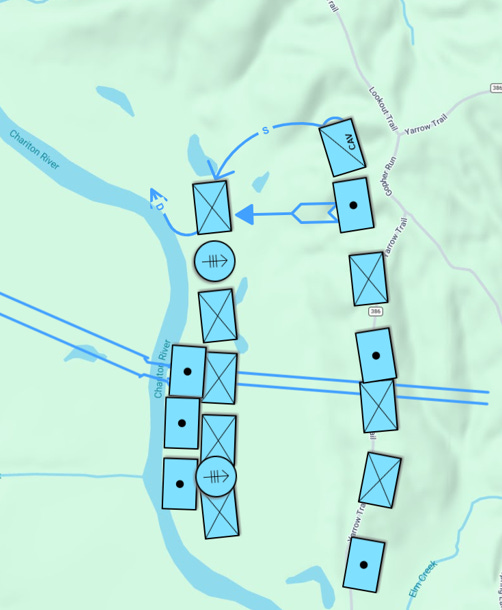
The army that Jesse Lovelace is with turns south, and forces a final battle with the FSA outside St Louis in July. Cut off, and under attack from two directions, the FSA surrenders. Part of the CSSA Army of Missouri is sent east to reinforce the eastern theater, while the rest (including Jesse) spend the remainder of the war making incursions into Iowa and Illinois.
British Intervention
The fall of Richmond is a serious blow to the CSSA, as one might imagine. With naval supremacy on the Atlantic coast and the majority of Southern forces in the east defeated, the spring of 1856 finds the FSA poised to push deeper into the Southern heartland. However, the British Empire has other plans.
The British Foreign Office was quietly relieved at the breakup of the United States, as this ends the rise of a potential rival power. Although the British are opposed to the slavery still practiced in the CSSA, British industry needs access to Southern cotton. With the fall of Richmond, it appears that the FSA is on its way to becoming a continental power again, and this is something Britain can’t allow.
In April 1856, the British Navy meets and defeats the FSA Navy in the Battle of the Chesapeake Bay. At the same time, a fleet uses the Welland Canal to travel from Lake Ontario to Lake Erie, defeats the small FSA naval contingent there, and bombards Cleveland, Ohio.
Faced with the prospect of a British Expeditionary Force landing at Baltimore and cutting off the army in Richmond; and of another British Army driving south from Cleveland to Virginia, cutting the country in two, the FSA is forced to negotiate in June 1856.
The Treaty of Havana
The FSA, CSSA, and British Empire meet for treaty talks in Havana, Cuba. Although British intervention likely saved the CSSA, the FSA holds a good deal of Southern territory, and the British are reluctant to commit land forces. The British indicate their unwillingness to back the CSSA if they seek a return to status quo ante bellum. The CSSA at this point is very much dominated by Virginia, and the needs of Virginia take primacy in the negotiation. Richmond, the capitol, is returned to the CSSA, as well as the important port of Baltimore. The FSA returns the captured areas of the Delmarva Peninsula, and then cedes the Free State of Delaware to the CSSA; never again will the FSA be able to threaten Richmond so easily.
These concessions come at a price: the CSSA cedes the coal regions of Kentucky between the Licking River and the Virginia border and down to the Tennessee state line, to the FSA. Once again, Virginian territory remains untouched. Further west, the portion of Missouri north of the Missouri River becomes FSA territory, even though the FSA never conquered it.
Aftermath
Although not total, the Border War of 1855-56 was an unalloyed defeat for the CSSA. In the years after the war, the Southern government centralizes, forsaking the laissez-faire attitude that led to their defeat. The new government aggressively pursues a policy of mass industrialization and militarization, and also begins to look to the Caribbean for new territories to conquer, to replace those lost.
The Free States of America, have learned their lesson about ignoring Britain. They begin a naval buildup to challenge the Royal Navy on the high seas and the Great Lakes. Frustrated in their attempt to expand southward, they turn their attentions to the western frontier.
Technology
In our timeline, both Lincoln’s War and World War I were especially brutal for the men who fought them, because technology had outpaced tactics. In the Fiddler’s Green universe, the Border War was where this effect first took place. On the high seas, the CSSA’s wooden naval ships with fixed guns attempted to turn broadside to FSA swiveling turrets gunboats, with predictably disastrous results. In the battle described in Chapter 6, the FSA infantry attempt to stand against rapid fire steam-powered artillery, and are blasted to pieces. Moments later, a Southern horse cavalry regiment charges a primitive machine gun. In the sieges of Baltimore, Richmond, and St Louis, long range steam cannon firing high explosive shells lead to widespread loss of life among the population.
The mass death of 20th Century warfare has come to the 1850s, and as the novel goes on, it only gets worse.
PS - If you like alternate history, check out my previous short novel The New World, a Southern Gothic retelling of Apocalypse Now/Heart of Darkness set in a world where the German Empire won WWI. Read the first six chapters on Substack, or:
Military symbols and battle staff memories